Types of Master’s Degrees: A Comprehensive Guide to Graduate Education
A master’s degree is an advanced postgraduate qualification undertaken after a bachelor’s degree. It is higher in status than a Bachelor’s degree and lower in status or gravitas than the Doctorate degree. It is sometimes referred to as “second degree” because it is the next level of academic progression after the Bachelor’s degree (also commonly referred to as the first degree). It deepens knowledge in a particular discipline, strengthens research and analytical abilities, and may prepare graduates for specialized professional practice, management, leadership, research or doctoral education.
Master’s programmes differ considerably. Some are taught and professionally oriented, some are research-intensive, and some combine coursework with a thesis or capstone project.

Master of Arts (MA)
The MA is common in humanities, social sciences, communication, languages and related disciplines. It develops advanced critical thinking, writing, qualitative research, interpretation and policy-analysis skills.
Master of Science (MSc/MS)
The MSc emphasizes scientific, quantitative and technical study. It is common in science, engineering, computing, health, economics, data science and environmental disciplines. Many programmes include advanced statistics, research methods, laboratory work or computational analysis.
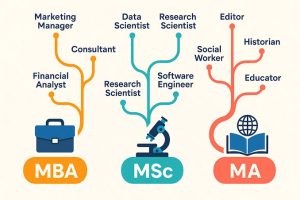
Master of Business Administration (MBA)
The MBA is a professional management degree covering strategy, finance, marketing, operations, human resources, organizational behaviour, entrepreneurship, analytics and leadership. It is often pursued by professionals seeking management or executive advancement.
Master of Education (MEd)
The MEd prepares educators and education leaders for advanced teaching, administration, curriculum development, assessment, educational technology, counselling and policy roles.
Master of Public Health (MPH)
The MPH prepares professionals to improve population health. Common concentrations include epidemiology, biostatistics, environmental health, global health, health promotion, health economics and health policy.
Master of Nursing (MN/MSN)
The MN or MSN builds advanced nursing knowledge for clinical specialization, education, leadership, administration and research. Possible areas include adult health, critical care, mental health, paediatrics, neonatal nursing, oncology, community health and nursing education.
Master of Engineering (MEng)
The MEng is generally professionally oriented and develops advanced engineering design, systems thinking, project management, innovation and applied problem-solving skills.
Master of Technology (MTech)
The MTech emphasizes applied technological development, industrial systems, automation, information technology, robotics, renewable energy, electronics and other technology-driven fields.
Master of Laws (LLM)
The LLM allows lawyers and legal professionals to specialize in fields such as international law, human rights, commercial law, constitutional law, intellectual property, tax, environmental and maritime law.
Master of Public Administration (MPA)
The MPA prepares professionals for government, public institutions and development organizations. Subjects commonly include public policy, public finance, governance, strategic management, human resources, programme evaluation and ethics.
Master of Social Work (MSW)
The MSW develops advanced skills in clinical practice, community development, child protection, healthcare social work, mental health, family services, policy and advocacy.
Master of Fine Arts (MFA)
The MFA is a terminal professional degree in many creative disciplines. It may focus on creative writing, theatre, film, photography, visual art, dance, animation or digital media.
Master of Architecture (MArch)
The MArch provides advanced architectural education in design, sustainable architecture, urban design, building technology, professional practice and heritage conservation.
It is important to note that in many universities in Africa and the rest of the world, students offering MA, MEd and MSc programmes do not undertake thesis or dissertation. Instead, they may write a term paper or exams at the end of their coursework in order to obtain their qualification.
Master of Philosophy (MPhil)
According to Cone & Foster (2006), there is no universal consensus on the use of the terms ‘dissertation’ and ‘thesis’. Universally, the distinction between dissertation and thesis is murky. In the United States, for example, thesis tends to be associated with master’s degrees while dissertation tends to be associated with doctoral degrees. However, some U.S. universities use the two terms interchangeably.
At the University of Cape Coast, the term ‘dissertation’ is associated with professional and practice-oriented master’s degrees while the term ‘thesis’ is associated with academic master’s and doctoral degrees – (i.e. the Master of Philosophy, Commerce, Nursing and the Doctor of Philosophy).
The MPhil is a research-intensive postgraduate qualification in many universities. It usually requires substantial independent research and a thesis and can provide strong preparation for doctoral study. The MPhil or other Masters programmes that offer a thesis or dissertation is often considered the highest form of the masters degree due to the fact that the students attain mastery of a construct or constructs in a field and become masters of that field of study due to the research involved, be it thesis or dissertation.
Project work, dissertation, and thesis have one main generic purpose: to give students guided practice in conducting independent research and presenting the results thereof. Regardless of the type, the realization of this generic purpose consists of demonstrating the ability to:
i. identify or define problems for investigation;
ii. generate questions and/or hypotheses that guide investigation;
iii. review, summarise, and critique existing literature;
iv. apply appropriate methods of investigation;
v. design data collection instruments and collect data;
vi. analyse data, discuss the results and draw conclusions;
vii. derive implications and make recommendations based on findings;
viii. think and write clearly, critically and coherently; and,
ix. present the results or findings orally and/or publish the results.
Executive Master’s Degrees
Executive master’s programmes are designed for experienced professionals. Examples include the Executive MBA, Executive Master of Public Administration and executive healthcare or leadership programmes. They often use weekend, evening or modular schedules and emphasize strategic leadership and real-world organizational problems.
Special considerations:
Master’s by Research
A Masters degree by research places substantial emphasis on independent investigation and thesis writing, often with limited formal coursework. It is particularly appropriate for students intending to pursue research careers or doctoral study.
Research Master’s versus Coursework Master’s
Coursework master’s programmes rely more heavily on taught modules, assignments, examinations, projects and sometimes a smaller dissertation. Research master’s programmes place greater emphasis on independent investigation and a substantial thesis.
Neither model is universally superior. The appropriate choice depends on whether the student’s priority is professional advancement, specialized practice, academic research or progression to a doctorate.
Admission Requirements For a Master’s Degree
Common requirements include a recognized bachelor’s degree (with most cut off points at the 2nd lower division) , academic transcripts, an acceptable grade point average or classification, references, a CV, a statement of purpose and, where relevant, evidence of language proficiency.
Research programmes may require a research proposal. Executive and professional programmes may also require relevant work experience. Exact requirements vary by institution and country.
General scope of work in Master’s Degrees without Thesis or Dissertation
A Masters degree can be purely research based or combined with coursework. A Masters degree with coursework usually dedicates the first year to academic work. It requires a couple of credit hours, could be up to 50 credit hours , divided into two equal parts over a period of two semesters. In some jurisdictions, students would take written exams at the end of each of the two semesters in other jurisdictions, students are required to take term papers instead of written exams,
A term paper is a research-based academic assignment that students write at the end of a semester or quarter to show what they have learned. It tests the students’ understanding of the course material and their ability to research a topic independently. It is much longer than a standard essay, usually ranging from 5 to 20 pages (about 1,500 to 5,000 words). It counts for a large percentage of your final grade for the course. It follows a formal academic structure and uses standard citation styles like APA, MLA, or Chicago.
The student would then ensure that he submits all the term papers for all the courses which they have been assigned and meet the exact credit hours to be able to graduate from the programme he undertook. The student may be required to provide other documents to authenticate the completion of his/her programme.
Having done that successfully, the Graduate or Post Graduate School of his University would notify him of his eligibility to graduate via a call, mail or text .Beyond this stage, he is added to the graduating list of the next congregation and added to the graduation book of that congregation per the university’s practice or protocol. In some universities, the student receives his Masters degree before the day pf graduation. In other universities, he receives it on or after the day of graduation.
General scope of work in Master’s Degrees with Thesis or Dissertation
Students offering an MPhil and any other Master’s degree that requires research typically s research (thesis or dissertation) would start the process after their full year of coursework in the first year. To begin with, the thesis or dissertation would require a research topic/idea that would be finetuned and approved the student’s supervisor (usually a senior member of the University with a doctorate degree, ie, a Doctor or a Professor).
Upon approval, the student prepares a proposal and defends it before an academic panel on a scheduled date. After a successful defense of the thesis or dissertation proposal .The proposal is often written in future tense and often limited to Chapters 1 ,2 and 3 (Introduction, Literature Review and Methodology).
After a successful defense of the proposal, the student obtains an ethical clearance from his University’s Institutional Review Board (or a similar board) and another ethical clearance from the institution he intends to undertake the research or designated Institutional Review Board in academia and field work, which the institution or company is affiliated to.
Following the collection, analysing and interpretation of the data collected , the student submits the firs draft of his final work (at this point, Chapter 1 to 5, or sometimes Chapter 1 to Chapter 6 ,written in the past tense ) to the University’s Graduate/Post Graduate School or his Department of study. The submitted work must usually meet a plagiarism index before being submitted to the Graduate or Post Graduate Schools in many universities and especially in UCC as matter of principle. A plagiarism index (more accurately called a similarity index or similarity score) is a percentage score generated by text-matching software—such as Turnitin or iThenticate—that shows how much of a submitted document matches other existing texts in their databases.
At the graduate/post graduate school level, the thesis/dissertation is marked by a supervisor or in some vcases, supervisors , usually an external supervisor from the Graduate school and an internal supervisor from the student’s faculty or department ( usually , a lecturer with a PhD), with the rank of a senior lecturer or above.
After marking, the student is scheduled for a thesis/dissertation defense by his or her department .On the day of defense, the student is given a fixed amount of time where he faces an academic panel and presents a summary of his/her thesis from Chapter 1 to 5 or Chapter 1 to 6 in some universities. The panel then interrogates his or her work. The student is expected to have reasonable, if not total mastery of his work by answering most if not all the questions posed by the academic panel and or address the concerns and issues raised about his work, by justifying the literature he used, the methods he employed , the software and tools he used in his analysis of the data and the conclusion and inference he has drawn from the data he collected and the thesis/dissertation he has put together.
Upon a successful defense , the student is provided with the supervisors’ (external and internal, in cases where the student had both) comment and recommendations of his work as well as the concerns raised and the correction made by the academic panel that oversaw his defense. He is then given a fixed time frame to effect the corrections in his work. Once that is ready, he presents the second draft of his final copy of his work to his department. It is again proofread to ensure that indeed, the student has effected all the corrections and changes made in the recommendation.
Once the student passes this stage, he submits the final draft of his thesis or dissertation electronically to the Graduate/Post Graduate school in addition to a hard bound copy. Some Universities take either or both. In many universities, the submission of the final thesis is accompanied by the ethical clearance and the plagiarism index for that was run on the final draft of the thesis or dissertation. When the student passes this stage, he is added to the graduating list of the next congregation and informed of his graduation date via a call, a mail or text. In some universities, the student receives his Masters degree on or after the day of graduation. In other universities, the student receives his degree a few days or weeks after submitting his work electronically or manually.

Advantages and Challenges of a Master’s Degree
A master’s degree can provide specialization, stronger employability, professional advancement, leadership preparation, research competence and access to doctoral study.
Challenges include tuition and living costs, demanding coursework, dissertation pressure and balancing study with employment and family responsibilities.
Choosing the Right Master’s Degree
Students should consider career objectives, programme content, accreditation, faculty expertise, research facilities, industry links, funding, study mode, duration and professional licensing requirements.
The best master’s programme is one that creates a clear connection between the student’s previous education, current interests and intended career direction.
Future Trends
Master’s education is increasingly incorporating online and hybrid delivery, interdisciplinary programmes, artificial intelligence, data science, cybersecurity, digital health, climate and sustainability studies, industry partnerships and stackable credentials.
Conclusion
Master’s education represents an important bridge between undergraduate study and advanced professional or research careers. Whether the goal is specialization, management, clinical advancement, research or doctoral education, selecting the appropriate master’s pathway can substantially strengthen professional capability and long-term career prospects.
Source:
Admin’s Research Desk
Additional Sources:
UCC School of Graduate Studies GuidelinesFor Preparing and Presenting Project Work, Dissertation and Thesis
National University via https://www.nu.edu/blog/dissertation-vs-thesis/